500 #2 Power Supply Project - RT's Radio Home Page
Main menu:
-
 Home Page
-
Amateur Radio
- Caution: READ THIS FIRST!
- Bitten By the Radio Bug
- Station
- Vintage Transmitters
- Vintage Receivers
- Field Day
- Micellaneous Tube Projects
- E.F. Johnson Restoration
- Test Equipment
- British Iron
- Contact
500 #2 Power Supply Project
Amateur Radio > Vintage Transmitters
Background:
The EF Johnson Viking Five Hundred AM/CW transmitter was manufactured as a set of two major components, the Desktop RF Deck and the remote Power Supply/Modulator unit. These two units being connected together by plug-in cables. The separate units were necessary since power supply itself weighs around 120 pounds, while the RF deck weighs around 65 pounds.
What happened to the power supplies?
Manufacture of the Viking Five Hundred ended in 1964. AM operation had long been subject to annoying heterodyne interference by other stations on nearby frequencies, so during the 1960's, it was gradually superseded by Single Sideband (SSB) operation. The old heavy, wideband AM transmitters fell out of favor and were often relegated to the garage, other storage area or in sheds. When the owner passes away, the family members are completely unaware that the big, heavy unmarked power supply "box" is a necessary component serving the Viking Five Hundred RF deck, so many of these were sold off separately or sadly, went to the landfill.
The AM transmission mode never disappeared completely from the amateur radio scene. There are dedicated hams who still see value in the mode and enjoy operating these classic rigs.
The New Power Supply:
The "Viking 500 #2" RF deck detailed elsewhere on this site was separated from its power supply at some point in history. The RF deck is now operational, so the construction of the new power supply/modulator unit is underway and is detailed here.
A Viking Invader power supply chassis was initially intended as the base for the new power supply; however, extensive modifications would have been required.
A brand new chassis:
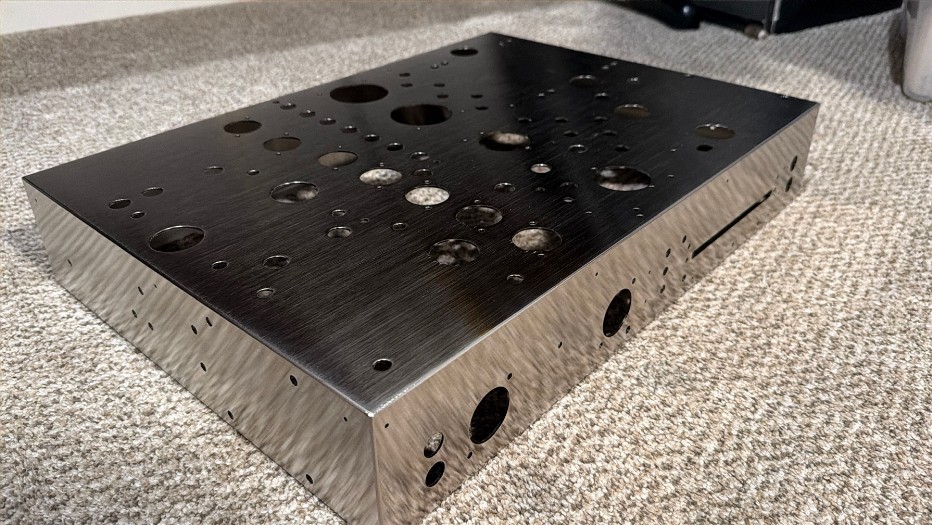
Chuck Hurley, K1TLI reached out to find hams who needed a new power supply chassis for orphaned 500 RF Decks. I committed to buy if he could produce them at a reasonable cost. Several other hams committed, and after a few months Chuck came through with a nice product.
The layout must have taken considerable time and effort. The machine work on the chassis is clean, and the nickel plating is well done. The original Johnson chassis was polished to a mirror finish prior to plating; this new chassis was not. Polishing would have likely added significant labor cost to the chassis, so it was best to skip that feature. A few more Viking Five Hundreds may have been saved due to the making of these new chassis; thank you Chuck!
Chuck Hurley does very nice work; here is a link to his website: https://johnsonradioresto.com/home-page

Another view of the new chassis.
Progress Photo coming soon.
To save money, I intended to use the low voltage transformer from the Invader 2000 power supply. It was possible, but circuit modifications were necessary including going with solid state rectifiers and coming up with a "virtual center tap" for the 811A filament winding. Giving the situation some thought, it became very clear the modifications required were not feasible, so I ordered a new Hammond PWDP13025 low voltage transformer. This added a month of leadtime and another $290.00 in cost to the project.
Using 3B28 tubes as opposed to using solid state rectifiers, the 3B28's add a little cushion to the high voltage power supply components when keying the transmitter. The 3B28's are shown are NOS and have a manufacturing date in the 22nd week of 1973. The Viking Five Hundred was orginally fitted with 866A rectifier tubes; these exhibit a nice blue glow during transmitting, but they can be risky to use since they contain liquid mercury. The tubes have been known to arc if not allowed to warm up several minutes after dormant periods or if the equipment has been moved. The arc can destroy the expensive high-voltage power transformer. 3B28's are a safer solution.